The Secret Navier Master Plan
(just between you and me)
By Sampriti Bhattacharyya
PS: I’ve always admired Tesla’s Master Plan — the clarity, the simplicity, and how it laid out why and how they were building for the future. Most companies keep their strategy secret, but when you’re solving hard technical problems, the real differentiation is in execution. We’ve gone against a lot of industry/startup norms to build Navier the way we have, given the scale of what we’re trying to achieve. I wanted to share our approach in a way that’s transparent and digestible to everyone following our journey.
As many of you know, Navier’s first product, the N30 Pioneer, is a high-end, luxury recreational boat. Looking at it, you might ask: "Do we really need another fancy boat for the wealthiest folks?"
As someone whose career has been defined by solving hard, fundamental problems—from particle accelerators at Fermilab to nuclear reactors and autonomous underwater drones at MIT—the answer is no. Nothing against wealthy people at all, but I did not leave the world of nuclear physics to build toys for the 1%.
But thinking that way misses the point of why we are doing it.
Some readers may not be aware of our long-term plan. We are building a next-generation American maritime company to fix an industry that is fragmented, outdated, and losing on the global stage. Hopefully, this writing connects the dots on how a luxury boat is the bridge to maritime dominance.
1. The Origin: Physics is the Only Law
I didn’t start my career thinking about boats.
I started with particle accelerators at Fermilab and designing nuclear reactors—places where the physics is unforgiving and the engineering has to be precise. From there, I worked on autonomous aircraft at NASA, then went to do my PhD at MIT to build the world’s first underwater swarm-capable autonomous micro-drones to inspect the insides of reactors.
Looking back, the through-line was simple: I was always drawn to hard, physical problems that everyone else was ignoring.
That experience taught me a lesson that defines Navier today in a quote that Elon put out, really well: Physics is the only law; everything else is a recommendation.
In fact, many of you may not know, Navier is named after a physicist– Claude Louis Navier of the famous Navier Stokes equation (they are essential for modeling fluid dynamics- which is unsolvable for 3 dimensional cases, and considered as one of the seven millennial prize problem)
When I started looking at the ocean in 2014/15, it was obvious that maritime was next in line for a revolution. Yet, venture Capitalists scowled at “defense” or “hardware.” They told me demand was too cyclic. Maritime isn’t for venture capital. I have a hundred emails from them, saying NO. Ironically, those same investors are now rushing toward patriotism… because it’s cool.
But we didn’t want this company to chase a trend. We built it because, from a first-principles perspective, the current maritime paradigm is broken. From my conviction that developed while in grad school.
2. The Problem: Why Boats (and the Industry) Suck
The maritime market currently suffers from a fatal combination of factors:
- Fragmented designs
- Bespoke, slow shipyards
- Enormous crew costs
- Reliance on fossil-fuel logistics
- Inefficient hulls, no standardized platform
This combination is economically inefficient—and strategically dangerous. China’s industrial machine is not slowing down. In a future of asymmetric warfare, the side that can produce scalable, inexpensive, long-range platforms will dominate.
Right now, that is not the United States.
To fix this, we have to look at the physics. If you strip away the nostalgia, traditional boats are terribly inefficient:
- Displacement hulls push water aside. That creates huge drag. You pour in energy, but most of it goes into making waves, not moving you forward.
- Energy use scales badly with speed. Pushing a traditional hull from 20 to 30 knots isn’t a 50% energy increase—it is often 3–4x.
- Sea state kills comfort and uptime. Slamming through waves destroys efficiency, breaks equipment, and makes passengers sick.
The Autonomy Trap People talk about autonomy as a savior, but software retrofits don’t fix bad physics. You can bolt autonomy onto a bad hull, but you just get autonomous inefficiency. It makes no sense to integrate advanced software layers onto platforms that fight the water.
The Solution: The Autonomous Hydrofoil By lifting the hull out of the water, we cut drag by up to 90%. This creates a physics base that actually deserves autonomy. It enables high speed, long range, and a smooth ride—all while slashing operational costs.
3. The Strategy: Why Start with Recreation? (The “Tesla Roadster” Phase)
If the goal is national security and mass transport, why start with a recreational boat?
- Speed of Iteration The transportation and defense industries are notoriously slow. If we had waited for a government contract, we would still be working on PowerPoint slides. We needed to move at the speed of Silicon Valley.
- The Manufacturing Reality We started production in Turkey. Why? Because no U.S. shipyard could move fast enough. We needed to build 20 boats a year immediately, not in five years. We could have raised hundreds of millions on hype, but we chose to get to work and build real stuff. This allowed us to generate revenue and prove the tech while we build out our U.S. factory.
- Data is Gold By putting the N30 into the hands of early adopters, we have logged thousands of hours of operation across diverse sea states. We are gathering data on foil control, energy management, and wave dynamics that no theoretical model could provide.
4. The Future: The Generalized Marine Vessel Platform (GMVP)
Electric is incredible. It is simpler, cheaper to maintain, and perfect for coastal applications (approx. 75nm range). But to truly dominate the seas, we need range.
This leads to Phase 2: The Hybrid Disruption.
We are developing the Generalized Marine Vessel Platform (GMVP). This is a “skateboard” architecture designed to optimize the three winning criteria for any vessel:
- Cost (Build, Scale, Operate)
- Range at Speed (Long missions)
- Diverse Sea Conditions (Seaworthiness)
The GMVP is a bare-bones, scalable foundation. The “superstructure” is secondary. Whether you build a ferry, a cargo carrier, or a defense vessel on top, the underlying OS and physics remain the same.
Our Tech Stack This isn’t just about hulls. It’s about a unifying Operating System and network. Our vessels share data, allowing us to iterate software updates across the fleet instantly. Furthermore, we are simplifying the design for robotic manufacturing. We are moving away from bespoke shipbuilding to automotive-style assembly.
5. Dual-Use: The Economic Engine
Dual-use is not a buzzword—it is the economic engine.
- Commercial fleets drive volume. (Ferries, logistics, water taxis).
- Defense missions drive capability. (Long-range, stealth, swarming).
- Shared manufacturing drives costs down.
Navier systems are already being evaluated and deployed in defense contexts today—quietly, but meaningfully. That story will become more visible soon.
In an age of asymmetric warfare, why build one giant aircraft carrier target? You need swarms of fast, long-range, autonomous vessels. A hybrid platform offers the range for long missions with the silence of electric drive when needed.
The Master Plan
So, in short, the master plan is:
- Build a high-performance electric recreational vessel (The N30) to prove the physics, gather massive amounts of data, and generate revenue.
- Use that data to iterate and build the winning platform ie. build the GMVP, a scalable “skateboard” platform (Hybrid & Electric) that solves the range and sea-state problems- the foundation
- Deploy this platform massively across commercial sectors to drive down unit costs through economies of scale.
- Leverage that scale to provide the U.S. Navy and allies with thousands of low-cost, high-tech, autonomous vessels.
Establish American maritime supremacy. Asymmetric answers for asymmetric threats.
Don’t tell anyone.
Sampriti
Founder, CEO, Navier
The Secret Navier Master Plan
(just between you and me)
By Sampriti Bhattacharyya
PS: I’ve always admired Tesla’s Master Plan — the clarity, the simplicity, and how it laid out why and how they were building for the future. Most companies keep their strategy secret, but when you’re solving hard technical problems, the real differentiation is in execution. We’ve gone against a lot of industry/startup norms to build Navier the way we have, given the scale of what we’re trying to achieve. I wanted to share our approach in a way that’s transparent and digestible to everyone following our journey.
As many of you know, Navier’s first product, the N30 Pioneer, is a high-end, luxury recreational boat. Looking at it, you might ask: "Do we really need another fancy boat for the wealthiest folks?"
As someone whose career has been defined by solving hard, fundamental problems—from particle accelerators at Fermilab to nuclear reactors and autonomous underwater drones at MIT—the answer is no. Nothing against wealthy people at all, but I did not leave the world of nuclear physics to build toys for the 1%.
But thinking that way misses the point of why we are doing it.
Some readers may not be aware of our long-term plan. We are building a next-generation American maritime company to fix an industry that is fragmented, outdated, and losing on the global stage. Hopefully, this writing connects the dots on how a luxury boat is the bridge to maritime dominance.
1. The Origin: Physics is the Only Law
I didn’t start my career thinking about boats.
I started with particle accelerators at Fermilab and designing nuclear reactors—places where the physics is unforgiving and the engineering has to be precise. From there, I worked on autonomous aircraft at NASA, then went to do my PhD at MIT to build the world’s first underwater swarm-capable autonomous micro-drones to inspect the insides of reactors.
Looking back, the through-line was simple: I was always drawn to hard, physical problems that everyone else was ignoring.
That experience taught me a lesson that defines Navier today in a quote that Elon put out, really well: Physics is the only law; everything else is a recommendation.
In fact, many of you may not know, Navier is named after a physicist– Claude Louis Navier of the famous Navier Stokes equation (they are essential for modeling fluid dynamics- which is unsolvable for 3 dimensional cases, and considered as one of the seven millennial prize problem)
When I started looking at the ocean in 2014/15, it was obvious that maritime was next in line for a revolution. Yet, venture Capitalists scowled at “defense” or “hardware.” They told me demand was too cyclic. Maritime isn’t for venture capital. I have a hundred emails from them, saying NO. Ironically, those same investors are now rushing toward patriotism… because it’s cool.
But we didn’t want this company to chase a trend. We built it because, from a first-principles perspective, the current maritime paradigm is broken. From my conviction that developed while in grad school.
2. The Problem: Why Boats (and the Industry) Suck
The maritime market currently suffers from a fatal combination of factors:
- Fragmented designs
- Bespoke, slow shipyards
- Enormous crew costs
- Reliance on fossil-fuel logistics
- Inefficient hulls, no standardized platform
This combination is economically inefficient—and strategically dangerous. China’s industrial machine is not slowing down. In a future of asymmetric warfare, the side that can produce scalable, inexpensive, long-range platforms will dominate.
Right now, that is not the United States.
To fix this, we have to look at the physics. If you strip away the nostalgia, traditional boats are terribly inefficient:
- Displacement hulls push water aside. That creates huge drag. You pour in energy, but most of it goes into making waves, not moving you forward.
- Energy use scales badly with speed. Pushing a traditional hull from 20 to 30 knots isn’t a 50% energy increase—it is often 3–4x.
- Sea state kills comfort and uptime. Slamming through waves destroys efficiency, breaks equipment, and makes passengers sick.
The Autonomy Trap People talk about autonomy as a savior, but software retrofits don’t fix bad physics. You can bolt autonomy onto a bad hull, but you just get autonomous inefficiency. It makes no sense to integrate advanced software layers onto platforms that fight the water.
The Solution: The Autonomous Hydrofoil By lifting the hull out of the water, we cut drag by up to 90%. This creates a physics base that actually deserves autonomy. It enables high speed, long range, and a smooth ride—all while slashing operational costs.
3. The Strategy: Why Start with Recreation? (The “Tesla Roadster” Phase)
If the goal is national security and mass transport, why start with a recreational boat?
- Speed of Iteration The transportation and defense industries are notoriously slow. If we had waited for a government contract, we would still be working on PowerPoint slides. We needed to move at the speed of Silicon Valley.
- The Manufacturing Reality We started production in Turkey. Why? Because no U.S. shipyard could move fast enough. We needed to build 20 boats a year immediately, not in five years. We could have raised hundreds of millions on hype, but we chose to get to work and build real stuff. This allowed us to generate revenue and prove the tech while we build out our U.S. factory.
- Data is Gold By putting the N30 into the hands of early adopters, we have logged thousands of hours of operation across diverse sea states. We are gathering data on foil control, energy management, and wave dynamics that no theoretical model could provide.
4. The Future: The Generalized Marine Vessel Platform (GMVP)
Electric is incredible. It is simpler, cheaper to maintain, and perfect for coastal applications (approx. 75nm range). But to truly dominate the seas, we need range.
This leads to Phase 2: The Hybrid Disruption.
We are developing the Generalized Marine Vessel Platform (GMVP). This is a “skateboard” architecture designed to optimize the three winning criteria for any vessel:
- Cost (Build, Scale, Operate)
- Range at Speed (Long missions)
- Diverse Sea Conditions (Seaworthiness)
The GMVP is a bare-bones, scalable foundation. The “superstructure” is secondary. Whether you build a ferry, a cargo carrier, or a defense vessel on top, the underlying OS and physics remain the same.
Our Tech Stack This isn’t just about hulls. It’s about a unifying Operating System and network. Our vessels share data, allowing us to iterate software updates across the fleet instantly. Furthermore, we are simplifying the design for robotic manufacturing. We are moving away from bespoke shipbuilding to automotive-style assembly.
5. Dual-Use: The Economic Engine
Dual-use is not a buzzword—it is the economic engine.
- Commercial fleets drive volume. (Ferries, logistics, water taxis).
- Defense missions drive capability. (Long-range, stealth, swarming).
- Shared manufacturing drives costs down.
Navier systems are already being evaluated and deployed in defense contexts today—quietly, but meaningfully. That story will become more visible soon.
In an age of asymmetric warfare, why build one giant aircraft carrier target? You need swarms of fast, long-range, autonomous vessels. A hybrid platform offers the range for long missions with the silence of electric drive when needed.
The Master Plan
So, in short, the master plan is:
- Build a high-performance electric recreational vessel (The N30) to prove the physics, gather massive amounts of data, and generate revenue.
- Use that data to iterate and build the winning platform ie. build the GMVP, a scalable “skateboard” platform (Hybrid & Electric) that solves the range and sea-state problems- the foundation
- Deploy this platform massively across commercial sectors to drive down unit costs through economies of scale.
- Leverage that scale to provide the U.S. Navy and allies with thousands of low-cost, high-tech, autonomous vessels.
Establish American maritime supremacy. Asymmetric answers for asymmetric threats.
Don’t tell anyone.
Sampriti
Founder, CEO, Navier
THE NAVIER DOCTRINE
Introduction
Most people know Navier through the N30 Pioneer—a futuristic, high-performance vessel that flies above the water, and to many appears, at first glance, to be a luxury boat straight out of science fiction. That is only the surface. Then, there are those of you who have heard about our applications for water taxis, and a few others who are familiar with our work in defense.
So far, we have been quiet about the full scope of what we are doing—the why and the how of it. What fewer people see is the deeper architecture we are building, the long-horizon strategy behind it, and the world that becomes possible when maritime technology is rebuilt from first principles. As we prepare to embark on a new chapter of products and technology for Navier, I wanted to share the reality of what we are building out here.
The Navier Doctrine connects those dots.
It is a roadmap—technical, strategic, and philosophical—for advancing humanity’s next frontier: the ocean. It lays out the first-principles logic behind our platform, the systems we are building, the decisions that shaped our early and upcoming products, and a vision for maritime transformation rooted in physics-driven design, autonomy, and scalable architectures.
Underlying this doctrine is a simple belief: Human progress has always been tied to water—exploration, trade, safety, and connection. Our future will depend on returning to it with better tools and better systems.
While the impact of this transformation is global, it also speaks to a challenge close to home. Once a maritime leader, the United States holds just 0.1% of global commercial shipbuilding capacity. Our merchant fleet, ferries, and workboats—the vessels that power economies—have fallen behind, burdened by aging infrastructure, regulations and outdated manufacturing. Rebuilding shipyards alone will not solve this. Maritime will only make economic and strategic sense again if we rethink it from the ground up—and the focus to win must be broader than just the Navy.
This doctrine lays out how we intend to achieve that: through scalable platforms, dual-use architecture, a shared technology stack, and a future where high-speed coastal mobility, affordable island logistics, faster transoceanic shipping, and resilient maritime defense all emerge from the same foundational technology.
I. The Origin — Physics Is the Only Law
I didn’t start my career thinking about boats. I started with particle accelerators and designing nuclear reactors at Fermilab—places where physics is unforgiving and engineering must be precise. From there, I worked on autonomous aircraft at NASA, and then pursued a PhD at MIT, building the world’s first swarm-capable underwater micro-drones to map the oceans.
The through-line was simple: I have always been drawn to the hardest physical problems, especially the ones everyone else overlooked. I am driven by the question: why doesn’t the solution exist yet, and what must be solved to build it?
Building a company around a high-end electric vessel was never the point. I didn’t see a niche luxury play. I saw an industry stuck decades behind, full of inefficiencies, and a set of hard problems that, if solved, could transform the final frontier on this planet at a scale few can imagine.
A lesson emerged early in my career, perfectly articulated by Elon Musk: “Physics is the only law; everything else is a recommendation.”
Navier takes its name from Claude-Louis Navier, the physicist behind the Navier–Stokes equation—the mathematical foundation of fluid dynamics and one of the seven Millennium Prize Problems. At its core, maritime engineering is applied physics.
This conviction solidified in 2014, when the world watched a modern airliner—Malaysia Airlines Flight 370—simply vanish into the ocean. We didn’t know how to find it. Autonomous rovers were being sent to Mars, the skies filled with drones and satellites, yet 70% of our own planet remained unmapped, uninstrumented, and strategically overlooked. While space captured the imagination, the oceans—our true economic and security lifelines—had atrophied.
I founded Hydroswarm–an underwater drone company– in 2015 to close this gap, spending years at MIT as a PhD student developing core IP in controls, marine swarm coordination, and hydrodynamic design. That technology eventually found a home with a major defense prime, but my work was far from finished.
We didn’t build Navier because maritime is a “hot sector” or because defense tech is trending. Navier is the culmination of 15 years of rigorous work in maritime and aerospace, born from the realization that the industry was finally ready for innovation, driven by both technological maturity and urgent geopolitical and national security needs.
It is an attempt to rebuild an entire industry from the ground up. We are solving the fundamental inefficiencies of speed, drag, and scale with a hardcore First Principles approach, grounded in the belief that the next great frontier belongs to those who treat it with rigor, discipline, and the immutable laws of physics.
II. The Status Quo — What’s Broken and Why It Matters
At Navier, we are solving a two-fold problem: a technological stagnation that has made water transport economically unviable, and a strategic decline that has left the United States vulnerable.
A. Maritime Is Antiquated
While the automotive and aerospace industries spent the last century optimizing for efficiency, scale, and software integration, maritime technology effectively anchored itself in the 1950s. Modern hulls and propulsion systems have seen only incremental improvements, and the consequences are severe: we have limited what is possible on the water by accepting physics that we should have engineered around.
Civilization began on the water. But in the 20th century, we abandoned waterways for highways as automotive transport became cheaper, faster, and more predictable. Maritime fell behind not because water is irrelevant—but because boats remain fundamentally broken across three dimensions we call the 3Cs: Cost, Comfort, and Convenience.
Cost: Traditional hulls must push through water, which is roughly 1,000× denser than air. The result is massive hydrodynamic drag. A conventional planing hull is ~15× less energy-efficient than a car. Worse, this penalty is non-linear: as speed increases, energy consumption grows exponentially, not linearly. High speed on water quickly becomes uneconomic.
Comfort: Conventional boats are at the mercy of sea state. Vertical accelerations—slamming—reduce passenger comfort, limit uptime, and introduce safety risks. In a world accustomed to the smoothness of a Tesla or a high-speed train, no one accepts a commute that is physically punishing. Comfort isn’t a luxury; it’s a prerequisite for adoption.
Convenience: Maritime transport is hard to access. For people, it’s constrained to a small number of ferry terminals. For goods, to a handful of major ports. The idea of highspeed water taxis—or the equivalent of semi-trucks on water—largely doesn’t exist. We have ferries. We have cargo ships. What’s missing is a flexible, distributed, high performance network in between.
B. America Has Lost Maritime Leadership
How do we solve this as an American company when the country has ceded its shipbuilding capability? The contrast between our history and our current reality is stark.
In the wake of WWII, the U.S. led the world in shipbuilding, producing thousands of Liberty and Victory ships with unprecedented speed. Today, that industrial base has evaporated. The numbers paint a grim picture of our commercial maritime standing:
The Output Gap: China currently produces over 1,700 ocean-going commercial vessels per year (accounting for over 50% of the global market). The United States produces fewer than five.
The Fleet Collapse: Since 1960, the number of U.S. private oceangoing merchant vessels has plummeted by over 80%, leaving us with a fleet of fewer than 200 ships in international trade.
Global Standing: By tonnage and order book volume, the United States now ranks 14th in global shipbuilding.
This is not just an economic failure; it is a strategic crisis. We did not prioritize shipbuilding, we allowed the Jones Act to insulate the market rather than innovate it, and we let our merchant fleet erode.
The result is a Navy confronting adversaries who deploy cheap, numerous, asymmetric systems while we rely on legacy platforms that are too expensive to risk. A Ford-class aircraft carrier costs around $13 billion. A modern weaponized drone costs a few thousand dollars. In a conflict, an adversary does not need to match our budget; they only need to overwhelm our defenses with volume.
We cannot solve this by simply pouring concrete for new shipyards to build old designs. We have to change the unit economics of the vessel itself.
III. The Solution — The Autonomous Hydrofoil
In part 1 of the doctrine we will focus on vessels < 250ft.
To build vessels worthy of a maritime revival, we must first fix the physics. Specifically, the problem of hydrodynamic drag.
Our solution: active hydrofoils.
Hydrofoils aren’t new—navies and programs like the Boeing Foiling Jet proved the physics decades ago. What was missing was the enabling stack: sensors, control systems, computing, and manufacturability to make a reliable flying vessel at scale. Today, low-cost compute, modern sensing, advanced manufacturing and electric/hybrid propulsion finally make hydrofoiling scalable.
Think of hydrofoils as wings operating underwater. In our design, three struts descend from the hull, each ending in wings equipped with adjustable flaps—functioning much like the control surfaces of an airplane. Because water is nearly 1,000 times denser than air, these wings can be significantly smaller than aircraft wings while still generating immense lift.
Once the vessel reaches a certain speed (16 kts for the N30, our first vessel), the wings lift the hull entirely out of the water. This eliminates the friction of the hull pushing through the waves, reducing hydrodynamic drag by up to 90%.
High speed with dramatically lower energy consumption.
Radically extended range.
Smooth “flight” over waves, independent of sea state.
The Efficiency Multiplier The math behind this is compelling. A hydrofoil system reduces drag by 90% compared to a planing hull (a 5-6x hydrodynamic advantage). Simultaneously, an electric drivetrain is 3x more thermally efficient than a combustion engine. When you compound these gains, the result is staggering: An electric hydrofoil operates at roughly 10x the total system efficiency of a gas boat. This isn’t an incremental improvement; it is a platform shift
Autonomy: The Software Layer Autonomy is a worthy problem, but it only works well if the physics work first.
Software retrofits cannot fix bad physics. They only automate inefficiency.
If you automate a traditional boat, you are simply removing the driver from a vehicle that is still too expensive to run and too uncomfortable to ride. Hydrofoils provide the physical foundation; autonomy provides the scalable software layer.
This distinction is critical for unit economics, especially in smaller vessels (<100ft). A USCG licensed captain costs ~$35–40/hr, whereas an Uber driver costs ~$12/hr. In the current model, operating costs are roughly split 50% fuel and 50% labor.
By solving for drag, we slash energy costs. By solving for autonomy, we slash labor costs. Together, these solutions address both cost and comfort, creating a new class of marine vessels that can open up a whole new transportation network that was never possible before.
IV. Outinnovating, not just outnumbering —The GMVP
We cannot outdo China by playing in their own game: cost and volume. Even robotic factories are not a silver bullet. To win, we must stop playing their game and double down on what America does best: creating compounding leverage through superior technology.
The battle for the next-generation maritime ecosystem will not be won by building bespoke vessels one at a time. It will be won by building scalable platforms—a maritime equivalent to the aerospace “airframe” or the EV “skateboard” chassis.
At Navier, we call this the GMVP (Generalized Marine Vessel Platform).
The GMVP is engineered around three non-negotiable criteria:
Cost Efficiency: Designed to be built, operated, and scaled at a fraction of traditional costs.
Range at Speed: Pure electric for high-speed coastal missions; hybrid-electric for 8003,500+ nm endurance.
Seaworthiness: Stability and performance across diverse sea states.
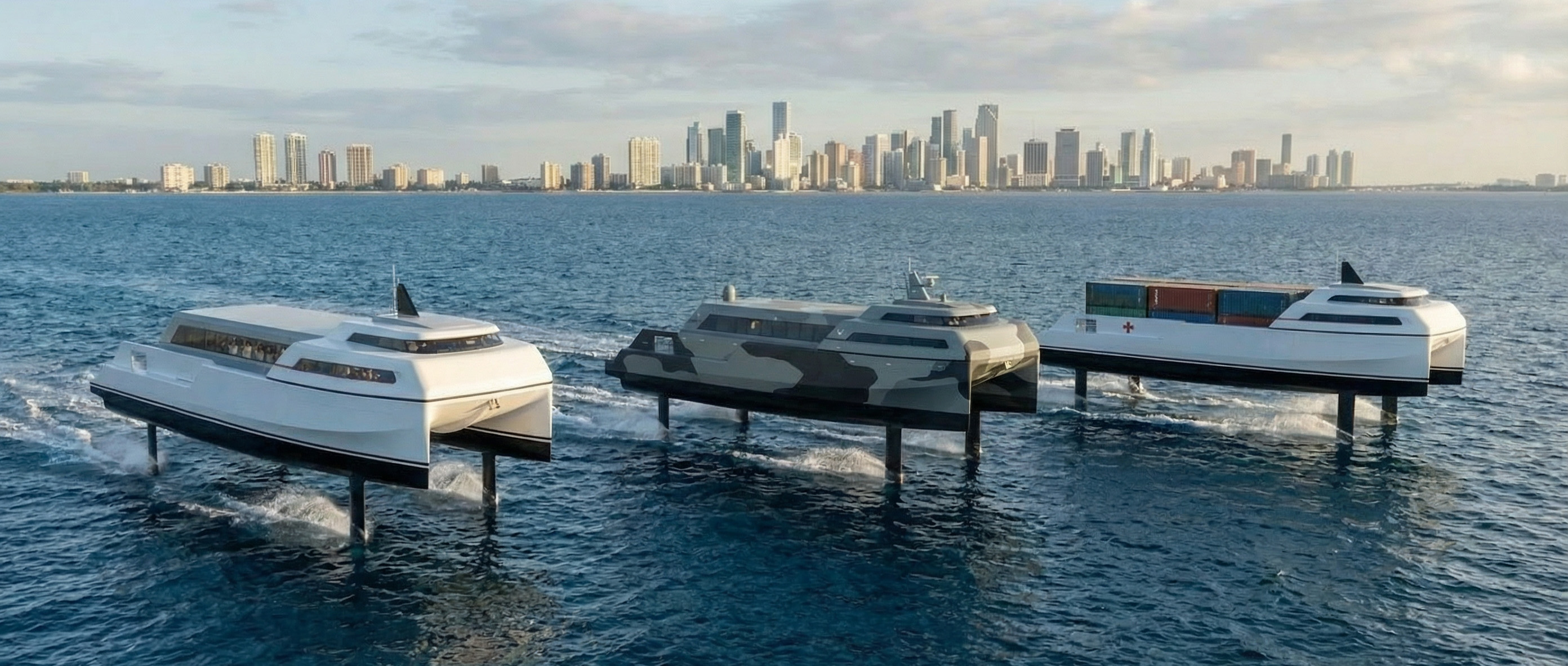
Crucially, the superstructure is secondary. The platform is the constant and you only build a few scalable variants (monohull/catamaran, a few different lengths). On this single, unified chassis—sharing the same core OS, propulsion, foils, autonomy, and infrastructure—we can deploy:
The Dual-Use Advantage Dual-use is not just a buzzword; it is the only way to scale maritime innovation effectively. By producing this platform for commercial markets, we drive down unit costs through volume—something defense budgets alone cannot achieve. This is the power of Commercial Off-The-Shelf (COTS) technology: we lower the cost curve by solving for the mass market first.
This creates a strategic reserve. Non-defense vessels built on this architecture are effectively “pre-certified” hardware. In times of conflict, commercial fleets can be rapidly repurposed, meaning we can surge capacity without waiting years for new keels to be laid.
Asymmetric Leverage This is what “out-innovating” looks like in practice. Because of our hydrofoiling efficiency and long-range hybrid capabilities, a Navier vessel can undertake multiday missions with minimal refueling. This solves the tyranny of distance in theaters like the IndoPacific.
We do not need to match our adversaries hull-for-hull. We can achieve superior coverage with fewer vessels because ours are faster, have better endurance, better ship to ship connectivity and coordination and ability to respond as a coordinated, intelligent swarm. Speed, range, and connectivity coupled with the best allow us to cover more water with less steel.
V. Why We Began With Recreation — The Proof Phase
If the goal is national competitiveness in mass transportation and defense, why start with the N30 Pioneer?
When we founded Navier during the chaos of COVID, capital had largely abandoned transportation—and maritime along with it. The prevailing belief was that a remote-first world would eliminate the need to move people. That never aligned with reality. Human psychology demands connection, and movement is fundamental to civilization.
The constraints were practical and unforgiving. Public water transit and defense adopt slowly. Scalable electric mobility depends on infrastructure that didn’t yet exist. Waiting years for contracts or grid upgrades while burning capital wasn’t an option. We needed a path that let us prove the physics, generate data, and move fast—on our own terms.
We chose recreational boat market not as an endpoint, but as a strategic wedge because it offers:
Speed of Iteration: Recreation allows us to move at the speed of consumer tech, shipping products while others draft requirements and get thousands of hours of real world data in various sea states. This helped us to design and build the GMVP.
Manufacturing Readiness: While our first two boats were built in Maine, there was no shipyard ready to scale N30 carbon fiber hulls in the US. We used the N30 to figure out how to build carbon fiber hulls in the U.S., bringing production home. All technology development and integration happens in our US factory in Alameda, CA.
A Testbed for Physics: The N30 was a rigorous validation of our core stack: flight control, foil dynamics, and autonomy behaviors, system reliability.
The N30 was the first node in a new maritime network, not the destination.
VI. The World Navier Aims to Build — The Sea-Shift
This Doctrine is not just about vessels and maritime tech stack. It is about the world that this architecture makes possible. When you drop the cost of maritime transport by 10x and increase the speed by 2x, you don’t just get a better boat—you unlock a new economic topology.
1. Coastal America: The Blue Highways
Impact: A network faster than a taxi and cheaper than a helicopter for the 46% of people living in coastal cities.
2. Island Nations: Decoupling Cost from Geography
The Problem: The “Island Tax.” Supply chain friction drives costs up 20-40%.
The Solution: Hybrid-Electric Foiling Logistics.
The Physics: We combine the efficiency of a barge with the 3x the speed.
Impact: By deploying autonomous, mid-sized vessels, we slash OpEx. We don’t just move goods; we lower the cost of living.
3. Transoceanic: The Mid-Mile Revolution
The Problem: Global shipping relies on brittle “Megaships” (Pipeline Logistics). One choke point breaks the chain.
The Solution: “Packet Logistics.” Agile, autonomous, mid-size freight.
Impact: A resilient mesh network that prioritizes frequency over capacity.
4. Defense: Asymmetric Naval Dominance
The Problem: We cannot out-build China’s shipyards in a symmetrical contest of steel.
The Solution: Out-innovate, don’t outnumber.
GMVP Economics: Dual-use technology allows us to deploy Mass without the “Military Price Tag.
Range Revolution: Hybrid drives enable 2,000nm+ range and weeks of silent station-keeping.
We fight Network-to-Hull. A swarm that our adversaries cannot catch, hide from, or starve out.
VII. The Doctrine in Five Steps
Prove the physics: Build America’s first production hydrofoiling vessel (N30) to validate lift, control, and efficiency in real seas.
Deploy fast, learn faster: Place a limited number of vessels with early adopters globally across diverse sea states to generate real-world data.
Abstract the platform: Use that data to design a formidable, generalized marine vessel platform (GMVP) — electric where it fits, hybrid where it’s required.
Design for dual use: Apply the same core platform across commercial mobility and defense to drive cost down and capability up.
Build the tech stack in parallel: Software, controls, autonomy, and manufacturing systems designed for scale from day one.
Scale autonomy across the fleet: Reduce crew dependency, lower operating costs, and multiply presence on the water.
VIII. Back to the to the Sea
For fifteen years, I have worked on the hardest problems in aerospace, maritime robotics and autonomy—underwater, overwater, defense, communications, and platform design. Navier is the culmination of that work. We built it because physics demanded it, the country needed it, and the future depended on it.
As President John F. Kennedy reminded us:
“We are tied to the ocean… and when we return to it, we are going back from whence we came.”
This is the Navier Doctrine.
This is how we will build the next great maritime company.
Sampriti Bhattacharyya
Founder & CEO